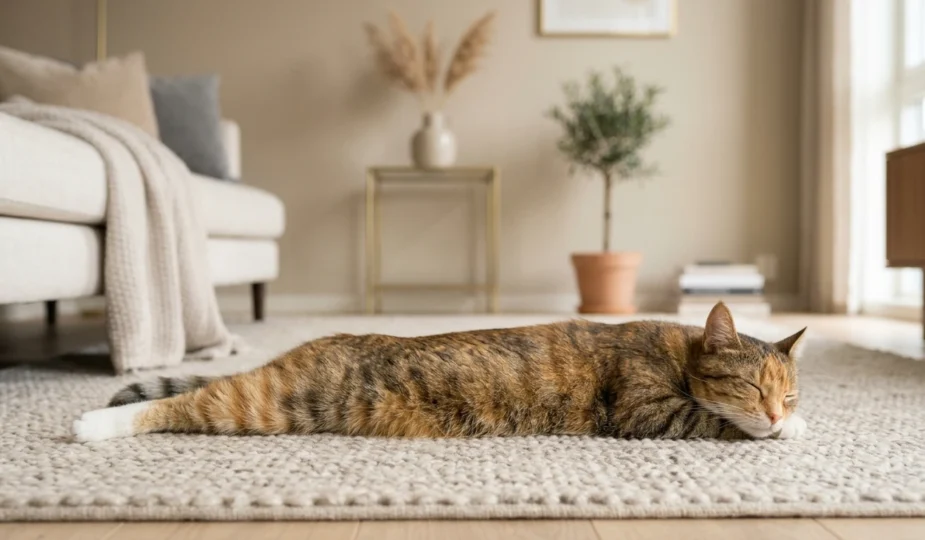
Have you ever walked into a room and found your cat lying flat on its belly, with both back legs stretched straight behind it?
It almost looks like your cat is doing a tiny frog pose or practicing yoga on the floor. And if you’ve seen this adorable position, you may have wondered: What does cat splooting mean?
This funny-looking position has become popular among cat lovers, and it even has its own name: splooting.
But is your cat simply getting comfortable, stretching its muscles, or trying to cool down?
Let’s look at why cats sploot, what this position tells you about your cat, and when you should pay closer attention.
What Is Cat Splooting?
Cat splooting is a resting position in which a cat lies on its belly with one or both hind legs extended behind or to the side of its body.
Instead of keeping its back legs tucked underneath, your cat stretches them out, sometimes making its body look like a little frog.
There are several variations of this position:
- Full sploot: Both hind legs are stretched straight behind the body.
- Half sploot: One hind leg is stretched behind while the other remains tucked underneath.
- Side sploot: One hind leg extends out to the side while the other stays closer to the body.
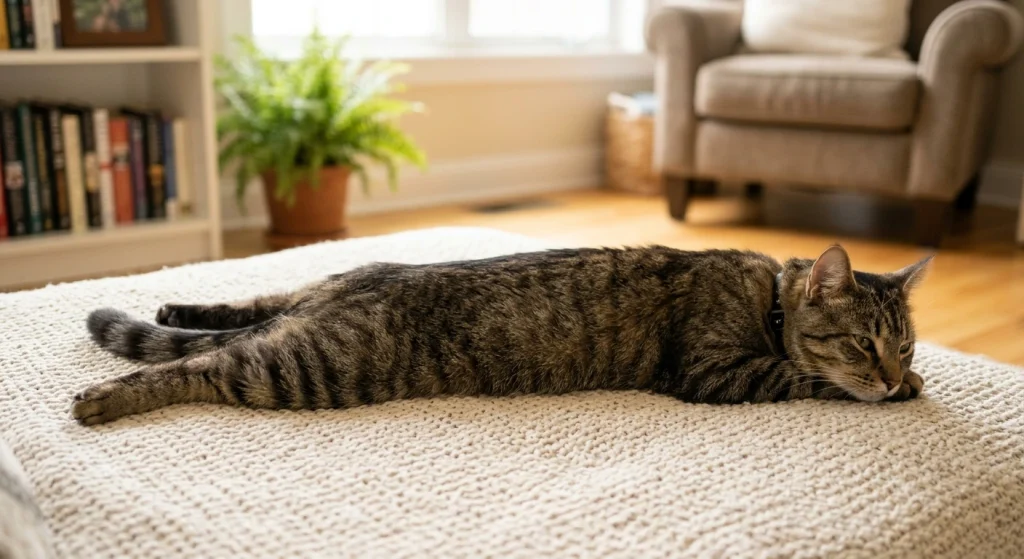
The position may look unusual, but many cats find it comfortable.
Why Do Cats Sploot?
There isn’t just one reason cats assume this position. Splooting can be related to comfort, stretching, temperature regulation, and individual flexibility.
Here are some possible explanations.
1. Your Cat Is Simply Comfortable
One of the most common reasons a cat sploots is that it feels comfortable in its surroundings.
When a cat stretches out on a soft rug, a cool floor, or a familiar spot, it may simply be settling into a position it enjoys.
If your cat looks relaxed, has normal breathing, and gets up and moves around easily, the sploot may just be another one of its favorite resting positions.
Cats have their own preferences, and not every cat rests in the same way.
2. Your Cat May Be Trying to Stay Cool
Have you noticed your cat splooting more often during warm weather?
The position may help your cat cool down, especially when it is lying on a cool surface such as tile or stone.
By spreading more of its body against the floor, your cat may be able to release some body heat.
Veterinary experts at VCA Animal Hospitals explain that pets may sploot on cool surfaces to help regulate their body temperature.
If your cat is looking for cool places to rest, make sure it always has access to fresh water, shade, and a comfortable environment.
3. Your Cat Is Stretching Its Muscles
Sometimes, splooting looks like a little yoga session.
Extending the hind legs may stretch the muscles around the hips and legs. Your cat might assume this position after playing, running around the house, or waking up from a nap.
According to VCA Animal Hospitals’ explanation of pet splooting, this position can provide a full-body stretch and may help relieve tension around the back and hips.
So, the next time your cat stretches out like a tiny superhero, it may simply be enjoying a good stretch.
4. Your Cat May Be Naturally Flexible
Cats are known for their impressive flexibility, and some seem especially comfortable stretching their hind legs in unusual directions.
Kittens, in particular, may adopt the splooting position because younger animals often have greater flexibility.
However, flexibility varies from one cat to another. Some cats love splooting, while others never seem interested in it.
And that’s perfectly normal.
5. Your Cat Has Found Its Favorite Resting Position
Just like people have favorite sleeping positions, cats have their own preferred ways to relax.
Some curl into tiny balls, others stretch out on their sides, and some tuck their paws underneath their bodies.
Splooting may simply be one of your cat’s favorite ways to rest.
If your cat regularly assumes this position without showing signs of discomfort, it may just be part of its individual personality.
Is Cat Splooting a Sign That Your Cat Is Happy?
It can be a sign that your cat feels comfortable, but the position alone cannot tell you exactly how your cat feels.
Look at the rest of its body language.
A relaxed splooting cat may have:
- Soft, relaxed muscles
- Normal breathing
- Ears in a natural position
- Calm facial expressions
- No obvious signs of discomfort
- The ability to stand up and walk normally
Your cat may also close its eyes, groom itself, or fall asleep while resting in this position.
However, remember that cats can sometimes hide discomfort. A change in their usual behavior deserves attention, especially when other symptoms appear.
Is Splooting Bad for Cats?
Not necessarily. Splooting is generally not something you need to worry about when your cat is otherwise healthy and comfortable.
However, there are situations where this position may deserve a closer look.
According to VCA Animal Hospitals, splooting can sometimes occur alongside painful hip or joint problems, injuries, or mobility issues.
Pay attention if your cat:
- Suddenly starts splooting when it never did before.
- Has difficulty getting up from the floor.
- Walks stiffly or limps.
- Seems reluctant to jump or climb.
- Cries, growls, or reacts when you touch its legs or hips.
- Becomes less active or stops playing.
- Shows other noticeable changes in behavior.
A veterinary review, the 2022 ISFM Consensus Guidelines on the Management of Acute Pain in Cats, explains that cats may show pain through changes in posture, movement, activity, and social behavior.
This is why it is important to look at the whole picture rather than judging a cat’s health by one resting position.
If your cat suddenly changes its usual behavior, shows signs of fear or discomfort, seems painful, or has difficulty moving, contact your veterinarian to find out what might be wrong.
Why Does My Cat Sploot With One Leg Out?
Some cats stretch only one hind leg behind them while keeping the other tucked underneath their body.
This is called a half sploot.
It may simply be a comfortable variation of the position. Cats do not always stretch both legs equally, and their preferred resting positions can vary.
However, if your cat consistently avoids using one leg, limps, or seems uncomfortable when moving, it is worth arranging a veterinary examination.
The important distinction is whether your cat is choosing a relaxed position or showing signs of difficulty moving normally.
Why Does My Kitten Sploot So Much?
If you have a kitten, you may notice that it seems to sploot everywhere.
Kittens are often very flexible and may enjoy stretching their bodies into different positions while resting or playing.
You might find your kitten splooting on a blanket, a cool floor, or even in the middle of its play area.
As long as your kitten is active, eating normally, playing, and moving comfortably, the position is usually not a reason for concern.
Enjoy those adorable moments. They make wonderful cat pictures!
Do All Cats Sploot?
No. Some cats seem to love this position, while others rarely or never do it.
Whether a cat sploots can depend on its individual preferences, flexibility, comfort, and environment.
You may also notice that your cat only sploots in certain places, such as on cool floors during warm weather or on a soft blanket after playing.
There is no need to encourage your cat to sploot. Let it choose whichever resting position feels comfortable.
Frequently Asked Questions About Cat Splooting
What does it mean when a cat sploots?
Cat splooting usually refers to a cat lying on its belly with one or both hind legs stretched behind or to the side. It may be a comfortable resting position, a stretch, or a way to lie against a cool surface.
Is splooting a sign of a happy cat?
It can be a sign of comfort, especially when your cat has relaxed muscles, normal breathing, and moves around normally. However, the position alone does not prove that a cat is happy.
Why does my cat sploot on the cold floor?
Your cat may enjoy the cool surface, especially during warm weather. Lying with more of its body against the floor may help it release body heat.
Do kittens sploot more than adult cats?
Kittens may sploot because younger animals are often more flexible. However, adult cats can enjoy the position too.
Should I be worried if my cat suddenly starts splooting?
Not necessarily, but a sudden change in posture deserves attention if it comes with stiffness, limping, difficulty getting up, reduced activity, or signs of pain. Contact your veterinarian if you notice these changes.
Can I encourage my cat to sploot?
There is no need to encourage it. Provide comfortable resting areas and let your cat choose its preferred position. Never force its legs into a stretch.
Final Thoughts: Enjoy Your Cat’s Little Yoga Moments
Cat splooting is one of those adorable behaviors that makes living with cats so entertaining.
Whether your feline friend stretches out like a tiny frog, relaxes on a cool floor, or takes a little break after a playful afternoon, this position may simply be part of its unique personality.
As long as your cat moves comfortably and shows no signs of pain, you can enjoy those funny little splooting moments.
And if you manage to capture a perfect sploot photo, consider yourself lucky. Your cat has just given you another reason to fill your camera roll!