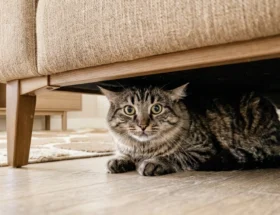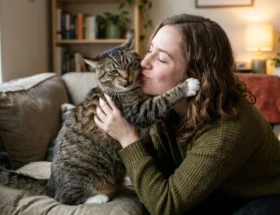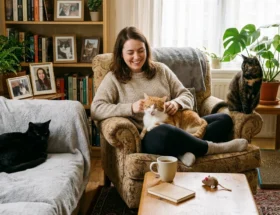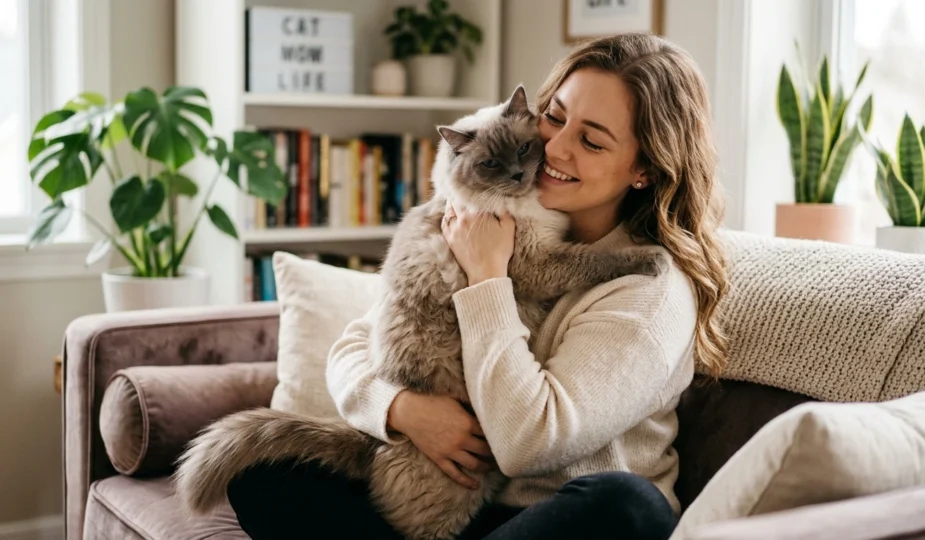
Have you ever noticed that your cat seems to follow one woman around the house, curl up beside her, and ignore everyone else?
Maybe your cat runs to greet its female owner but barely reacts when a man walks through the door. Or perhaps you’re the person who feeds, plays with, and cares for your cat, yet it still seems to have a favorite human.
This raises an interesting question: Do cats prefer female owners?
There is some research suggesting that cats and women may interact differently than cats and men. But that doesn’t necessarily mean cats naturally love women more.
The truth is a little more interesting. Cats may respond to the way people communicate, approach them, and respect their boundaries. Let’s look at why cats sometimes appear more attached to female owners and what makes a person their favorite human.
Do Cats Prefer Female Owners?
Not necessarily. There is no convincing evidence that cats automatically prefer women simply because they are women.
A 2021 review published in Frontiers in Veterinary Science, titled The Mechanics of Social Interactions Between Cats and Their Owners, examined research on how cats interact with people.
The review discusses differences in how men and women may interact with cats. For example, some observations found that women spoke to cats more frequently and that cats vocalized more often in response.
This doesn’t mean cats naturally prefer women. Instead, it suggests that differences in human behavior may influence the way cats respond.
In other words, your cat may not be choosing women over men. It may simply prefer the person who makes it feel most comfortable.
Why Do Cats Sometimes Seem More Attached to Women?
If cats don’t automatically prefer women, why do so many people notice their cats following female family members around?
There are several possible explanations related to the way people interact with their feline companions.
1. Women May Talk to Cats More Often
Talking to cats may seem a little silly to someone who doesn’t have a cat, but many cat owners do it naturally.
Research discussed in the 2021 review found that women and girls spoke to cats more often than men and boys in some observed households. Cats also vocalized more frequently with them.
Talking to a cat can become part of a daily relationship. Your cat may learn to associate your voice with attention, food, playtime, and familiar routines.
Of course, men who talk to their cats can build the same kind of connection.
2. The Way a Person Approaches a Cat Matters
Imagine two people meeting the same cat.
One person walks straight toward it, bends over, and immediately tries to pick it up. The other stays at a comfortable distance, speaks gently, and allows the cat to approach first.
Which person is more likely to make the cat feel comfortable?
Many cats prefer having control over social interactions. A person who approaches slowly, avoids sudden movements, and allows the cat to choose when to interact may have a better chance of earning its trust.
The review The Mechanics of Social Interactions Between Cats and Their Owners discusses how human interaction styles can influence the quality of the relationship between cats and their owners.
This is not a rule about how every woman or man behaves. Individual personalities and habits matter much more.
3. The Person Who Provides Daily Care May Become a Favorite
Cats can form strong associations with the people who make their everyday lives comfortable.
Think about the person who:
- Provides meals at regular times
- Keeps the water bowl clean
- Cleans the litter box
- Plays with the cat
- Notices when something seems wrong
- Provides a comfortable place to rest
These repeated experiences help build familiarity and trust.
If a woman in the household handles most of these responsibilities, the cat may naturally spend more time with her.
But the same is true when a man is the primary caregiver.
4. Respecting a Cat’s Boundaries Builds Trust
Some people love hugging and carrying their cats. Others prefer to let their cats decide when they want affection.
Cats often respond positively to people who recognize when they want attention and when they need space.
For example, if your cat walks away while you’re petting it, allowing it to leave can help it feel more comfortable around you.
A person who repeatedly forces contact may unintentionally make the cat avoid them.
This is one reason a cat might prefer someone who interacts less intrusively, even if that person isn’t the one who spends the most time trying to cuddle it.
Do Male Cats Prefer Female Owners?
You may have heard that male cats prefer women and female cats prefer men.
It’s an interesting idea, but there isn’t strong scientific evidence supporting a universal rule like this.
A cat’s sex does not reliably determine which human it will bond with. Individual personality, early socialization, previous experiences, and the quality of interactions all matter.
Some male cats are strongly attached to men. Some female cats follow their female owners everywhere. Others seem equally comfortable with everyone in the household.
Rather than assuming your cat prefers a particular gender, pay attention to the relationship it develops with each person.
How Do You Know If You’re Your Cat’s Favorite Person?
Cats don’t express affection in exactly the same way people do. Some are very cuddly, while others show attachment through quieter behaviors.
Here are a few signs that your cat may feel especially comfortable with you.
Your Cat Follows You Around
Does your cat follow you from room to room, even when there is nothing particularly interesting happening?
It may simply enjoy your company or feel comfortable staying near you.
Your Cat Sleeps Beside You
Cats are more vulnerable when sleeping. Choosing to rest beside you can be a sign that your cat feels safe and relaxed in your presence.
Your Cat Slow Blinks at You
A slow blink is often associated with relaxed, friendly communication between cats and humans. If your cat looks at you and slowly closes and opens its eyes, you can try returning the gesture.
Your Cat Greets You When You Come Home
Some cats wait near the door, meow, rub against their owners, or follow them around after they return.
These behaviors can be signs of familiarity and social attachment.
Your Cat Seeks You Out for Comfort
If your cat comes to you when it wants to rest, feels uncertain, or needs attention, it may see you as a familiar and reassuring presence.
Remember that no single behavior proves you’re your cat’s favorite person. Look at the overall relationship and how your cat behaves around you over time.
Can a Cat Have More Than One Favorite Person?
Absolutely!
Cats can form meaningful relationships with several people in the same household.
Your cat might enjoy playing with one person, sleeping beside another, and greeting a third person whenever they enter the room.
These relationships don’t have to look identical to be important.
A cat may also change its preferred companion depending on its mood, routine, or needs. For example, it might seek out the person who usually feeds it at mealtime but choose someone else when it wants a quiet place to sleep.
Having more than one trusted human is perfectly normal.
How to Become Your Cat’s Favorite Human
If your cat seems to prefer someone else, don’t take it personally. Building a relationship with a cat takes patience, and you cannot force affection.
Here are a few ways to develop a stronger bond.
1. Let your cat approach you. Avoid chasing it or forcing physical contact. Give it the opportunity to decide when it wants attention.
2. Become part of its daily routine. Offer meals, fresh water, playtime, and other positive experiences consistently.
3. Learn your cat’s body language. Notice when it enjoys being petted and when it wants to be left alone.
4. Spend time playing together. Interactive toys, such as wand toys, can help create positive experiences and encourage natural hunting behaviors.
5. Speak gently. Your cat may become familiar with your voice and associate it with calm, positive interactions.
6. Be patient. Some cats become affectionate quickly, while others need more time to feel comfortable.
The most important thing is consistency. A trusting relationship develops through repeated positive experiences, not by competing with other people for your cat’s attention.
Frequently Asked Questions
Do cats love women more than men?
There is no strong evidence that cats naturally love women more than men. Some studies have found differences in how men and women interact with cats, which may influence how cats respond to them.
Why does my cat prefer my girlfriend over me?
Your cat may be more familiar with her routine, voice, or way of interacting. She may also be the person who provides more daily care. Try allowing your cat to approach you, playing with it regularly, and respecting its boundaries.
Do cats prefer female voices?
There is not enough evidence to conclude that cats universally prefer female voices. Cats can recognize familiar voices and may respond to the way a particular person speaks to them, rather than the person’s gender alone.
Are male cats more affectionate than female cats?
Not necessarily. Some people describe male cats as more affectionate, but individual personality, socialization, health, and experiences play important roles. A cat’s sex alone cannot tell you how affectionate it will be.
Do cats choose one person as their favorite?
Some cats develop a particularly close bond with one person, while others have strong relationships with several household members. Their preferences may depend on familiarity, positive interactions, and individual needs.
Final Thoughts: Cats Choose Connection, Not Gender
So, do cats prefer female owners?
The research doesn’t support the idea that cats automatically choose women over men. What it does suggest is that cats respond to how people behave around them.
A gentle voice, a predictable routine, regular care, and respect for their boundaries can all help build a strong relationship.
Your cat doesn’t need you to be a woman or a man. It needs you to be someone it can trust.
And if your cat follows you everywhere, sleeps beside you, and greets you as if you’ve been away for years, you may already have a very special place in its little feline world.